

Get Started Now
Home > Insights > What is a Disposition?

What is a Disposition?

How criminal case outcomes are recorded in the court systems and why disposition information matters.

Coverage Map

A disposition is the current status or final outcome of a criminal case.

In court systems, the disposition explains what happened after criminal charges were filed. Dispositions are commonly included on criminal background checks because they help provide context about how a case was resolved.

Without disposition information, a criminal record may only show that charges existed, not whether the person was convicted, the case was dismissed, or the matter remains unresolved.

Why Dispositions Matter

A criminal charge by itself does not always explain the outcome of a case.

For example, two individuals may both have records showing the same criminal charge, but the cases may have ended very differently.

One case may have resulted in:

  • A conviction
  • A guilty plea
  • Jail time
  • Probation

The other may have resulted in:

  • A dismissal
  • An acquittal
  • Deferred adjudication
  • Diversion

The disposition provides important context about the outcome of the case and may affect how criminal record information is interpreted, evaluated, or if it is legally reportable under applicable laws.

Common Types of Dispositions

Dispositions can vary by jurisdiction, court system, and state law. However, several common disposition categories appear frequently during criminal record research.

Convicted

A conviction generally means the court determined the individual was guilty of the offense, either through a guilty plea or a court verdict.

Convictions may result in jail or prison sentences, probation, fines, court supervision, time served, or other court-ordered conditions.

Nolo Contendere (No Contest)

A nolo contendere plea, often called “no contest,” means the defendant does not admit guilt but accepts criminal penalties or court resolution without contesting the charge.

The legal effect and reporting treatment may vary by jurisdiction and applicable law.

Dismissed

A dismissal means the court closed the case without a conviction.

Cases may be dismissed for many reasons, including lack of evidence, witness issues, prosecutorial decisions, plea agreements, or procedural issues.

A dismissal does not necessarily mean the arrest or charge never occurred, but it does mean the case did not end in a conviction.

Pending

A pending disposition means the case is still active and has not reached a final outcome.

The case may still involve court hearings, plea negotiations, trial proceedings, sentencing, or diversion review.

Pending cases may eventually result in dismissal, conviction, or another resolution.

Deferred Adjudication or Diversion

Some courts offer programs that allow certain cases to be resolved without a traditional conviction if the individual successfully completes specific conditions. These conditions may include counseling, treatment programs, community service, probation, or other court requirements. Terminology varies by jurisdiction and may include terms like deferred adjudication, pretrial diversion, or mental health diversion.

When a court grants diversion, proceedings are suspended while the individual completes the program. Because no conviction has occurred and the case has not reached a final resolution, diversion cases are generally not reportable under applicable law. In California, Mental Health Diversion cases are specifically governed by Penal Code 1001.36 and are not considered reportable records.

This is a common source of confusion for employers. A fingerprint-based search or a criminal database may surface the underlying charge without indicating that diversion was granted. A properly reviewed background report evaluates the disposition of each record before reporting it. If that review does not happen, a non-reportable diversion case may appear to be an open or unresolved matter when it is not.

The final reporting outcome for deferred adjudication and diversion cases may differ depending on the court, the jurisdiction, and the applicable laws in that state.

Acquitted or Not Guilty

An acquittal means the court found the individual not guilty of the charges after the legal process concluded.

Why Disposition Information May Be Missing

Disposition information is not always available or complete.

Several factors can affect disposition reporting, including:

  • Court reporting delays
  • Incomplete electronic court records
  • Jurisdiction limitations
  • Database limitations
  • Older archived cases
  • Courts that do not report updated outcomes consistently

Some criminal databases may contain filing information but lack updated disposition details.

Relying only on a database search is not recommended, as databases generally do not provide the most current, reliable, or complete court information. Potential records identified through database searches should be confirmed at the county court level whenever possible.

Why Dispositions Can Be Difficult to Interpret

Disposition terminology varies significantly between jurisdictions.

Different courts may use different language to describe similar outcomes.

Examples include:

  • Deferred Entry of Judgment
  • Adjudication Withheld
  • Nolle Prosequi
  • Suspended Imposition of Sentence

These terms may have different meanings depending on the jurisdiction involved.

Some cases may also involve multiple charges with different dispositions within the same case.

How Disposition Information Is Used During Background Screening

Background screening providers may review disposition information to better understand:

  • Whether the case is still active
  • Whether a conviction occurred
  • The current status of the case
  • Whether additional court research may be necessary
  • Whether the record is legally reportable under applicable laws

Employers may also consider disposition information when evaluating job relevance, workplace safety considerations, hiring policies, and other factors related to the position.

Common Employer Misunderstandings

“An Arrest Means the Person Was Convicted”

Not necessarily. An arrest or criminal filing does not automatically mean the individual was convicted. The disposition helps explain what happened after the charge was filed.

“Dismissed Cases Mean Nothing Happened”

A dismissal means the case did not result in a conviction, but the underlying arrest or filing may still appear depending on the court system and applicable laws.

“All Courts Use the Same Disposition Terms”

Disposition terminology varies significantly between jurisdictions and court systems.

“Pending Means Guilty”

A pending case simply means the legal process is still ongoing and no final disposition has been reached.

Important: A criminal charge alone does not tell the full story of a case. The disposition reflects the current status or outcome of the case and may significantly affect how criminal record information is interpreted.

Final Thoughts

Disposition information helps explain the status or outcome of a criminal case after charges are filed.

Without dispositions, criminal records may provide incomplete context about whether a case resulted in conviction, dismissal, acquittal, diversion, or another resolution.

Because court systems vary significantly, disposition reporting and terminology can differ from one jurisdiction to another. Some records may also lack complete disposition information due to reporting delays or court limitations.

Understanding what dispositions mean helps employers better interpret criminal background reports and make more informed hiring decisions based on the available court information.

Related Articles

This article is provided for general informational purposes only and is not intended as legal advice.
Employers should consult qualified legal counsel regarding their specific compliance obligations under
the FCRA and applicable state or local laws.

Continue Exploring View All Articles
Home > Insights > Do Pending Charges Appear on a Background Check?

Do Pending Charges Appear on a Background Check?

When pending criminal charges may appear on background checks and how they can affect hiring decisions.

Coverage Map

Pending criminal charges may appear on a background check if the case has been filed in court and is legally reportable under applicable laws.

However, a pending charge is not the same as a conviction. It means the court process is still ongoing and the final outcome has not yet been determined.

What Is a Pending Criminal Charge?

A pending criminal charge means a criminal case has been filed, but the court has not reached a final resolution.

The case may still involve hearings, plea negotiations, diversion programs, trial proceedings, sentencing delays, or other court activity.

A pending case may eventually result in:

  • A dismissal
  • A conviction
  • Reduced charges
  • Deferred adjudication
  • Diversion
  • An acquittal

This is why employers should avoid assuming guilt based solely on the existence of a pending charge.

Where Pending Charges May Appear

Pending criminal charges most commonly appear through county criminal court searches because most criminal cases originate at the county level.

Depending on the jurisdiction, pending charges may appear in court indexes, dockets, county criminal searches, state repositories, or criminal databases.

Record availability varies significantly. Some courts update records quickly and provide detailed online access. Other courts may have delayed reporting, limited public access, or incomplete electronic records.

Are Pending Charges the Same as Convictions?

No. A pending charge is not a conviction.

A pending charge means the legal process has not reached a final outcome. Charges may later be dismissed, reduced, resolved through diversion, or result in a conviction.

This distinction matters because pending cases can change significantly before a final disposition is entered by the court.

Why Pending Charges Can Be Difficult to Interpret

Pending charges can create uncertainty because the available court information may be incomplete while the case is still active.

In some jurisdictions, records may only show basic information such as the filing date, initial charge, upcoming court dates, or case status.

Pending cases may also remain open for extended periods due to court backlogs, continuances, scheduling delays, ongoing investigations, or prosecutorial decisions.

Because the final outcome is unknown, employers should evaluate pending charges carefully and consistently.

How Employers Often Evaluate Pending Charges

Employers typically evaluate pending charges based on the position, the nature of the alleged offense, the severity of the allegations, workplace safety considerations, and applicable laws.

For example, a pending financial fraud case may be evaluated differently for an accounting position than for a warehouse position. While a pending DUI case may be especially relevant for a driving-related role.

Employers should also consider whether an individualized assessment or additional review is appropriate before making a final hiring decision.

State and Local Laws May Affect Reporting

Rules involving pending charges, arrests, non-conviction records, and criminal history reporting may vary by state or locality.

Some jurisdictions restrict how certain records may be reported or considered. Others impose timing requirements, Fair Chance Hiring obligations, Ban the Box rules, or individualized assessment requirements.

Employers should avoid assuming the same rules apply everywhere and should consult qualified legal counsel regarding specific compliance obligations.

The FCRA and applicable state laws impose reporting limitations on certain records, including non-conviction information. How those limitations apply to pending cases may depend on the jurisdiction and the ultimate disposition of the case. Employers should consult qualified legal counsel regarding specific reporting timelines.

Why Criminal Search Methodology Matters

Whether a pending charge appears may depend on the type of criminal search being conducted and the court system involved.

Factors that may affect reporting include:

  • County-level search coverage
  • Court update frequency
  • Search scope
  • Database limitations
  • Jurisdiction accessibility
  • Record verification procedures

Relying only on a database search is not recommended, as databases generally do not provide the most current, reliable, or complete court information. Potential records identified through database searches should be confirmed at the county court level whenever possible.

Common Employer Misunderstandings

“Pending Charges Mean the Person Is Guilty”

Not necessarily. A pending charge means the legal process is still ongoing and the final outcome is unknown.

“All Pending Charges Immediately Appear Everywhere”

Court reporting timelines vary significantly by jurisdiction. Some records may appear quickly, while others may not be immediately accessible.

“Pending Charges Always Result in Convictions”

Criminal cases can end in many different ways, including dismissal, reduction of charges, diversion, acquittal, or conviction.

“Every Employer Handles Pending Charges the Same Way”

Employers often evaluate pending cases differently depending on the position, industry, risk exposure, and applicable laws.

Important: Pending criminal charges are not convictions. A pending case means the court process is still ongoing, and the final outcome may change as additional information becomes available.

Final Thoughts

Pending criminal charges may appear on a background check, but visibility depends on the court system, jurisdiction, reporting practices, and search methodology involved.

Most importantly, employers should understand that pending charges are not convictions. A pending case simply means the court process is still ongoing, and the final outcome may still change.

When evaluating pending criminal charges, employers should consider job relevance, workplace safety concerns, applicable laws, and the fact that incomplete or evolving court information may not reflect the ultimate disposition of the case.

Background screening works best when employers balance workplace safety, fairness, consistency, and careful evaluation rather than relying on assumptions about unresolved criminal matters.

Related Articles

This article is provided for general informational purposes only and is not intended as legal advice.
Employers should consult qualified legal counsel regarding their specific compliance obligations under
the FCRA and applicable state or local laws.
Continue Exploring View All Articles
Home > Insights > How Criminal Records Are Stored and Searched

How Criminal Records Are Stored and Searched

What employers should understand about how criminal records are organized, searched, and matched during background screening.

Coverage Map

Many employers assume criminal records exist inside one large nationwide database that can instantly produce a complete criminal history by simply running a Social Security number.

That is not how criminal court systems work.

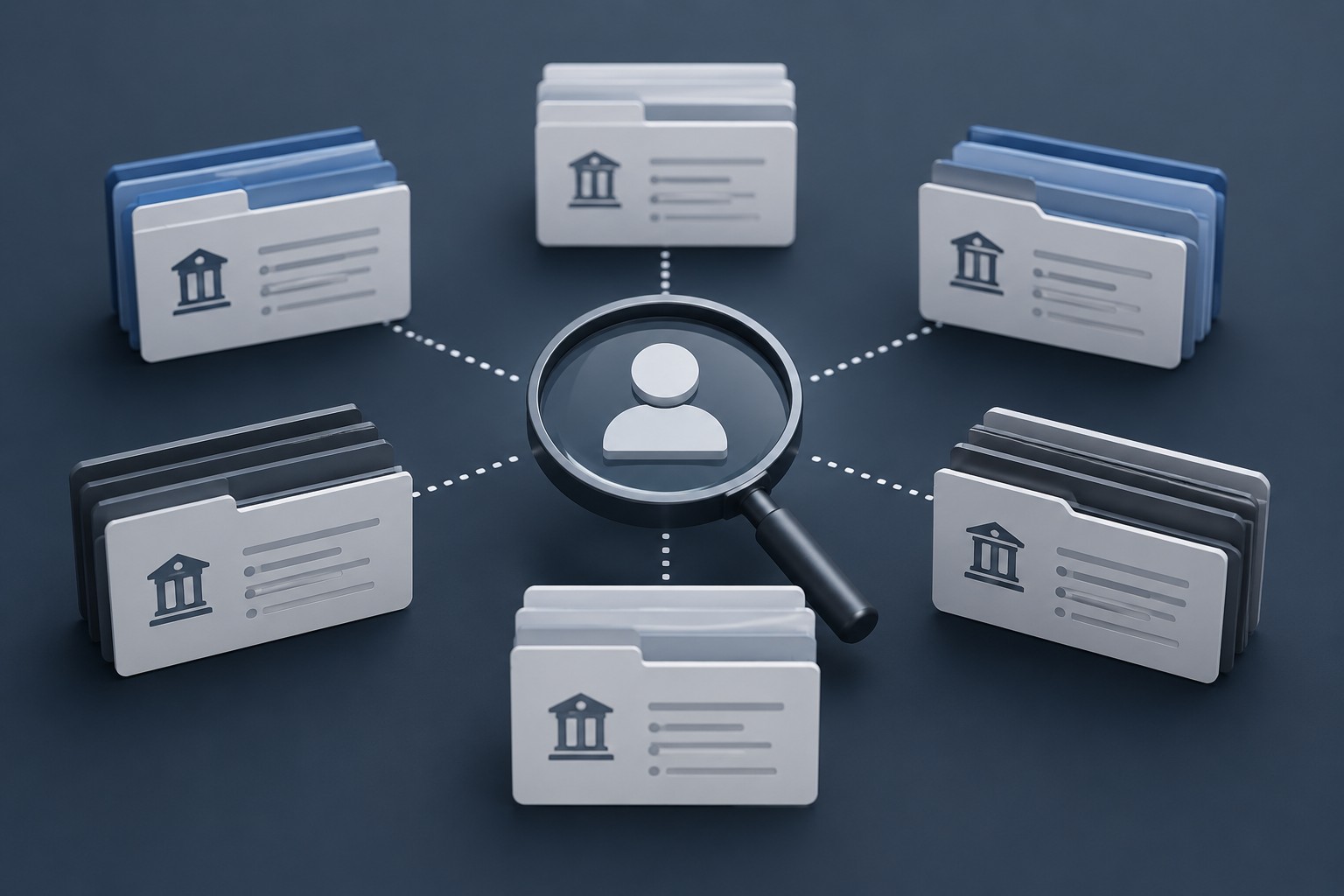
Criminal records in the United States are fragmented across thousands of separate jurisdictions, court systems, repositories, and databases. Courts maintain records differently, reporting standards vary by jurisdiction, and criminal records are typically organized and searched primarily by name rather than by Social Security number.

Understanding how criminal records are actually stored and searched helps employers better understand the background screening process and why criminal search methodology matters.


How Criminal Records Are Stored

Criminal records are generally stored within the court systems where criminal cases are filed and prosecuted.

In the United States, there is no single nationwide criminal court system that contains every criminal case.

Instead, criminal records are spread across thousands of separate jurisdictions, including:

  • County courts
  • State courts
  • Federal courts
  • Municipal courts
  • Specialized courts
  • State repositories
  • Correctional systems

Each jurisdiction maintains its own filing procedures, indexing systems, reporting standards, and public access rules.

Some courts provide modern online systems with searchable dockets and electronic case records. Other courts still rely heavily on manual retrieval procedures, clerk-assisted searches, or limited online indexing.

Because courts operate independently, the accessibility and quality of criminal record information can vary significantly depending on the jurisdiction involved.

This fragmented structure is one reason criminal background screening can become far more complex than many employers realize.


There Is No Single Nationwide Criminal Database

One of the biggest misconceptions about criminal background checks is the belief that a complete nationwide criminal database exists.

It does not.

No single database contains every criminal record in the United States.

While some databases aggregate information from multiple jurisdictions, participation and reporting vary substantially.

Some jurisdictions provide extensive updates and detailed reporting. Others may provide delayed reporting, limited information, incomplete disposition data, or no participation at all.

This means there is no single source capable of producing a guaranteed complete nationwide criminal history.

That is one reason employers often use layered screening packages that may include:

  • County criminal searches
  • Federal criminal searches
  • National criminal database searches
  • Sex offender registry searches
  • Employment or education verifications

Each search type serves a different purpose within the overall screening process.


Criminal Records Are Primarily Name-Based

Many employers believe criminal records are searched primarily using Social Security numbers.

In reality, most criminal court systems are primarily name-based.

Courts commonly organize and index records using combinations of:

  • First name
  • Middle name
  • Last name
  • Date of birth
  • Case number

This is because courts were designed for judicial administration and case management, not employment screening.

As a result, Social Security numbers are often:

  • Unavailable
  • Partially masked
  • Inconsistently stored
  • Non-searchable
  • Omitted entirely from public court records

The same is often true for:

  • Driver’s license numbers
  • Addresses
  • Other personal identifiers

When those identifiers do appear, they can be extremely helpful during record research and matching. However, they are not consistently available across jurisdictions.

Dates of birth are often one of the most valuable secondary identifiers available during criminal record research, but even DOB availability varies from court to court.

Because criminal records are primarily name-based, screening methodology and identifier analysis become very important parts of the background screening process.


Why Name Matching Can Become Complex

Criminal record matching is rarely as simple as locating an exact name match.

Several factors can complicate the matching process, including:

  • Common names
  • Nicknames
  • Alias usage
  • Maiden names
  • Hyphenated names
  • Data entry inconsistencies
  • Missing middle names
  • Similar dates of birth
  • Alternate spellings

For example, an individual named “Jonathan Smith” may also appear in court records as:

  • Jon Smith
  • John Smith
  • Jonathan A. Smith
  • Jonathan Allen Smith
  • J. Smith

Similarly, individuals who change names due to marriage or divorce may have records filed under previous legal names.

This is one reason background screening often involves reviewing multiple identifying factors rather than relying on a single exact-name match.

Proper matching procedures help reduce the risk of inaccurate reporting and improve consistency during the screening process.


Why Aliases Matter During Criminal Searches

Alias research is one of the most important but least understood parts of criminal background screening.

Because criminal records are name-based, records may exist under:

  • Prior married names
  • Maiden names
  • Nicknames
  • Alternate spellings
  • Hyphenated names
  • Abbreviated names
  • Prior legal names

If searches are conducted too narrowly, potentially relevant records may be missed.

This is one reason screening companies often review name history and associated identifiers when conducting criminal searches.

A properly developed alias history may help identify jurisdictions or records that would not appear under a single exact-name search.


County Courts vs. Federal Courts

Criminal records are not all stored within the same court system.

County courts and federal courts operate separately and maintain separate records.

County Courts

County courts handle the majority of criminal prosecutions in the United States, including many offenses employers commonly encounter during background screening, such as:

  • DUI offenses
  • Assault charges
  • Theft
  • Drug possession
  • Domestic violence
  • Local fraud cases

County criminal searches are often considered the foundation of employment background screening because most criminal records originate at the county level.

Federal Courts

Federal courts handle violations of federal law, including:

  • Wire fraud
  • Bank fraud
  • Interstate trafficking
  • Tax crimes
  • Federal conspiracy cases
  • Large-scale financial crimes

A county criminal search does not include federal criminal records, and a federal criminal search does not include county court records.

These systems operate independently and must be searched separately.


Criminal Record Availability Varies by Jurisdiction

Not all courts maintain records the same way.

Some jurisdictions provide:

  • Real-time online access
  • Detailed electronic dockets
  • Public digital case records
  • Broad searchable indexes

Other jurisdictions may require:

  • Clerk-assisted searches
  • Manual courthouse research
  • Limited public access
  • Delayed processing
  • In-person retrieval procedures

The quality and completeness of publicly accessible criminal records can vary dramatically from one jurisdiction to another.

This is one reason criminal search turnaround times and reporting depth can differ depending on where searches are conducted.


Why Criminal Searches Are Not Always Instant

Some employers expect criminal background checks to function like instant database lookups.

In reality, criminal background screening often involves multiple layers of research and jurisdiction analysis.

Depending on the court system involved, searches may require:

  • Manual review
  • Identifier analysis
  • Alias review
  • Court verification
  • Jurisdiction research
  • Clerk interaction
  • Record reconciliation

Some courts update records frequently, while others may have delays or inconsistent reporting structures.

As a result, more comprehensive criminal screening may sometimes require additional research time.


Common Employer Misunderstandings

Several misconceptions frequently create confusion about criminal background checks.

“There Is One Nationwide Criminal Database”

There is not. Criminal records are fragmented across thousands of independent jurisdictions and court systems.

“Criminal Searches Are Conducted by SSN”

Most criminal court systems are primarily name-based rather than SSN-based.

“All Courts Maintain Records the Same Way”

Court systems vary dramatically in accessibility, reporting practices, indexing quality, and public access procedures.

“All Criminal Records Are Instantly Available”

Some jurisdictions still require manual retrieval procedures or clerk-assisted research.

“One Search Covers Every Jurisdiction”

Criminal records are jurisdiction-specific. A search conducted in one county will not automatically include records from another county or another court system.

It’s also worth noting that what can be reported varies by state. Federal law sets the floor, but some states limit how far back criminal records, including convictions, can be reported, regardless of what a court search might find.


Why Screening Methodology Matters

The quality of a criminal background check depends heavily on the methodology used during the screening process.

Two screening providers may advertise similar services while using very different research procedures behind the scenes.

Factors that may affect screening quality include:

  • Jurisdiction selection
  • Name matching procedures
  • Alias development
  • Identifier analysis
  • Court access methods
  • Search scope
  • Research depth
  • Verification procedures

A faster or cheaper search does not necessarily produce the most complete or accurate results.

Under the Fair Credit Reporting Act, screening companies are required to follow “reasonable procedures to assure maximum possible accuracy” in their reports, which makes sound name matching and identifier analysis a compliance matter, not just a quality one.

This is one reason employers should understand how criminal records are actually stored and searched rather than assuming all criminal background checks operate identically.

Understanding the structure of criminal court systems also helps explain why search limitations, delays, and jurisdiction differences can occur during the screening process.


Important: Criminal records are not stored inside one nationwide database and are typically not searchable by Social Security number. Most criminal court systems are primarily name-based, and record availability varies significantly by jurisdiction.

Final Thoughts

Criminal records in the United States are not stored inside one centralized nationwide system. Instead, records are fragmented across thousands of separate jurisdictions, court systems, repositories, and databases that maintain records differently and operate independently.

Most criminal searches are primarily name-based rather than SSN-based, which makes identifier analysis, alias review, jurisdiction selection, and careful matching procedures important parts of the screening process.

Additional identifiers such as dates of birth, aliases, prior addresses, driver’s license numbers, or occasionally Social Security numbers may help narrow potential matches, but those identifiers are not consistently available across all court systems.

Understanding how criminal records are stored and searched helps employers better evaluate criminal background screening practices and better understand the limitations of simplified “instant search” assumptions.

Most importantly, employers should recognize that screening methodology matters. Effective criminal background screening often involves layered searches, jurisdiction analysis, name matching, and careful research procedures designed to improve accuracy and consistency.

A properly structured screening program helps employers make more informed hiring decisions while supporting workplace safety, consistency, and compliance.

Related Articles

This article is provided for general informational purposes only and is not intended as legal advice.
Employers should consult qualified legal counsel regarding their specific compliance obligations under
the FCRA and applicable state or local laws.
Continue Exploring View All Articles
Home > Insights > What is a National Criminal Database Search?

What is a National Criminal Database Search?

National criminal database searches help employers identify possible criminal records across multiple jurisdictions and are commonly used as part of broader employment background checks.

Time Hourglass

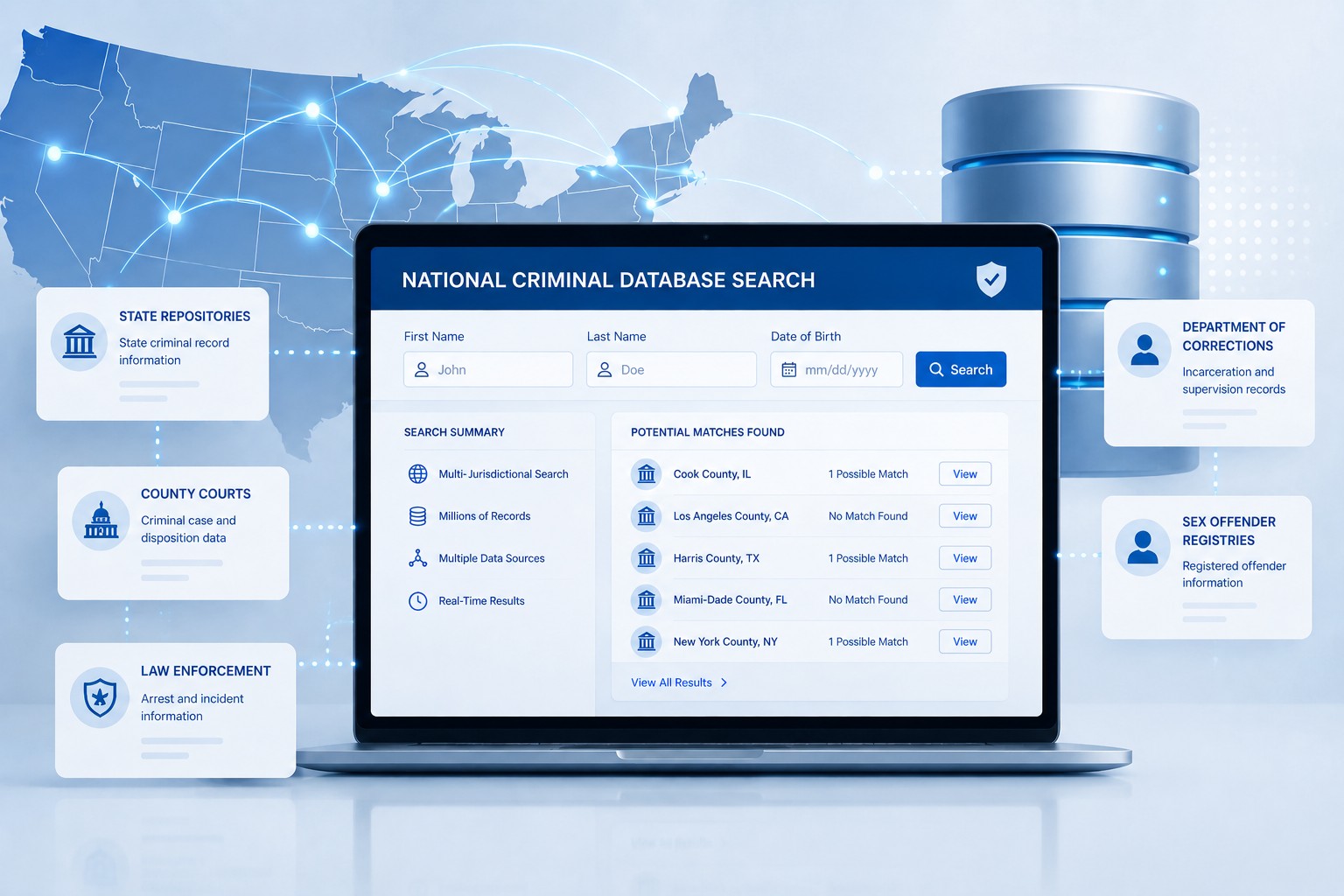
A national criminal database search, sometimes referred to as a multi-jurisdictional criminal database search, is commonly used as part of employment criminal background checks. These searches help employers identify possible criminal records across multiple jurisdictions quickly and cost-effectively.

However, many employers misunderstand what a national criminal database search actually does — and what it does not do.

Understanding how these searches work is important when building a compliant and reliable background screening program.

What Is a National Criminal Database?

A national criminal database is a large collection of criminal record information compiled from various public and proprietary sources across the United States.

Depending on the provider, database records may include information from:

  • County courts
  • State repositories
  • Department of Corrections records
  • Administrative office records
  • Sex offender registries
  • Watchlists and sanctions data
  • Other publicly available criminal justice sources

These databases are designed to help identify possible records associated with an applicant’s name and date of birth.

How Employers Use National Criminal Database Searches

National criminal database searches are primarily used as a screening tool to help identify jurisdictions that may require further investigation.

Because they can search millions of records quickly, they are commonly used to:

  • Expand search coverage
  • Identify records outside an applicant’s disclosed history
  • Increase screening efficiency
  • Help locate potential criminal records across multiple states

Many employers use multi-jurisdictional searches to identify possible records across multiple states and counties more efficiently.

Employers often include national criminal database searches as part of broader criminal background checks alongside county criminal searches, federal criminal searches, and SSN Trace results.

Important Limitations

A national criminal database search is not considered a complete criminal background check by itself and is therefore, not recommended as a stand-alone product.

Databases may contain:

  • Incomplete information
  • Delayed updates
  • Missing dispositions
  • Reporting gaps between jurisdictions

For this reason, potential records identified in a database search must be verified directly at the originating court before being reported on a criminal background check.

This court-level verification helps support accuracy and FCRA compliance.

Why County Criminal Searches Still Matter

County criminal searches remain one of the most important components of criminal background checks because criminal cases are typically filed and maintained at the county court level.

A county search may provide:

  • More current information
  • Better disposition details
  • More complete case information
  • Improved accuracy for employment decisions

National criminal database searches and county criminal searches are often used together rather than as replacements for one another.

What Information May Appear in a National Criminal Database Search?

Potential records may include:

  • Felony charges
  • Misdemeanor charges
  • Convictions
  • Pending cases
  • Incarceration records
  • Registered sex offender records

However, available information varies significantly depending on the reporting source and jurisdiction.

Final Thoughts

A national criminal database search can be a valuable tool for expanding search coverage and identifying possible criminal records across multiple jurisdictions.

However, database searches should generally be viewed as a supplement to court-level criminal background checks — not a replacement for them.

A well-designed screening program combines multiple search types to improve visibility, support compliance, and help employers make more informed hiring decisions.

Important: National criminal database searches may help identify possible records, but court-level verification should be performed before reporting records.

Related Articles

This article is provided for general informational purposes only and is not intended as legal advice.
Employers should consult qualified legal counsel regarding their specific compliance obligations under
the FCRA and applicable state or local laws.

Continue Exploring View All Articles
Home > Insights > County vs. Federal Criminal Searches

County vs. Federal Criminal Searches

What each search covers, when each search matters, and why they are not interchangeable.

County vs. Federal Criminal Searches

County criminal searches and federal criminal searches are both important parts of the background screening process, but they are not interchangeable. Each search covers different court systems, different types of offenses, and different reporting structures.

Understanding the difference between county and federal criminal searches helps employers build a more accurate and effective background screening program.

What Is a County Criminal Search?

A county criminal search reviews criminal records maintained by county-level courts. These courts handle the majority of criminal cases in the United States.

County searches are often considered the foundation of employment background screening because most criminal activity is prosecuted at the county level.

A county criminal search may reveal:

  • Misdemeanors
  • Felony charges
  • DUI offenses
  • Theft and fraud cases
  • Assault charges
  • Drug offenses
  • Domestic violence cases
  • Case dispositions
  • Sentencing information

What Is a Federal Criminal Search?

A federal criminal search reviews records from United States District Courts, which handle violations of federal law rather than state or local law.

Federal criminal cases are generally less common than county criminal cases, but they often involve more complex or large-scale offenses.

A federal criminal search may reveal:

  • Wire fraud
  • Bank fraud
  • Embezzlement
  • Tax evasion
  • Identity theft
  • Human trafficking
  • Interstate drug trafficking
  • Federal weapons violations
  • Large-scale financial crimes

Why County and Federal Searches Are Not Interchangeable

One of the most common misconceptions in background screening is that a federal criminal search automatically includes county records. It does not.

Federal courts and county courts operate as completely separate court systems.

That means:

  • A county criminal search will not reveal federal criminal cases
  • A federal criminal search will not reveal county criminal cases
  • Running only one search may leave significant gaps in coverage

For example, a DUI charge is typically prosecuted in county court, while a wire fraud case may appear in federal court. Employers who rely on only one type of search may miss relevant criminal history information.

Which Search Is More Important?

For most employers, county criminal searches are the most essential part of the screening process because the majority of criminal records originate at the county level.

However, federal criminal searches can provide valuable additional visibility for certain industries and positions.

The best approach often combines:

  • SSN Trace
  • County Criminal Searches
  • Federal Criminal Searches
  • National Criminal Database Searches
  • Sex Offender Registry Searches

How Employers Choose the Right Searches

The appropriate screening package depends on several factors, including job responsibilities, industry requirements, access to sensitive information, financial responsibility, driving responsibility, regulatory obligations, and workplace safety concerns.

For example, a warehouse position may require county criminal and MVR screening. An accounting role may also benefit from federal criminal searches. DOT-regulated positions may require additional compliance screening.

Employers should build screening packages based on actual risk exposure rather than relying on a one-size-fits-all approach.

Why Search Scope Matters

A limited search may create a false sense of security. Running broader, properly structured searches helps employers make more informed hiring decisions and maintain a more consistent screening process.

At the same time, employers should ensure all background screening practices remain compliant with federal, state, and local laws, including the Fair Credit Reporting Act.

Final Thoughts

County criminal searches and federal criminal searches serve different purposes within the background screening process. Neither search replaces the other, and both can play an important role depending on the position being screened.

A well-designed background screening program combines multiple search types to provide broader visibility, stronger consistency, and more informed hiring decisions.

Important: A federal criminal search does not include county criminal records, and a county criminal search does not include federal court records. Employers often use both searches together for broader coverage.

Related Articles

This article is provided for general informational purposes only and is not intended as legal advice.
Employers should consult qualified legal counsel regarding their specific compliance obligations under
the FCRA and applicable state or local laws.
Continue Exploring View All Articles